Estate Sale vs. Estate Cleanout: What's the Difference?
July 31, 2026
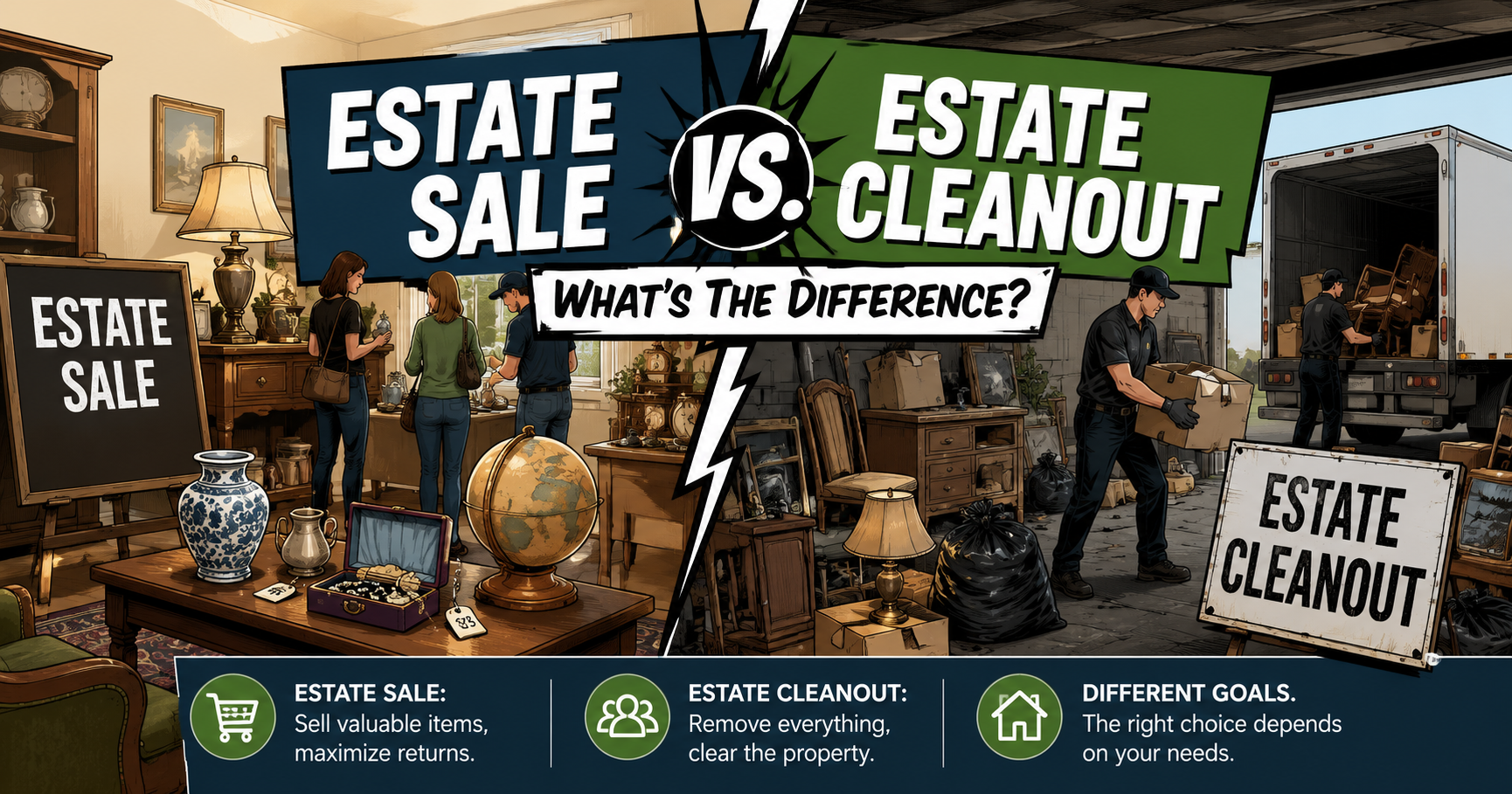
When it comes to settling a loved one's estate, downsizing, preparing a home for sale, or handling an inherited property, many people use the terms estate sale and estate cleanout interchangeably. While both services involve the contents of a home, they serve very different purposes and are designed for different situations.
Understanding the difference between an estate sale and an estate cleanout can save you time, money, and stress. Choosing the wrong service could mean leaving money on the table—or delaying the sale of a home that needs to be emptied quickly.
In this guide, we'll explain exactly what each service involves, when you should choose one over the other, and why many families ultimately benefit from using both.
What Is an Estate Sale?
An estate sale is a professionally organized sale where the contents of a home are offered directly to the public. Unlike a garage sale, an estate sale typically includes nearly everything inside the home—from furniture and antiques to kitchenware, collectibles, artwork, tools, and everyday household items.
Professional estate sale companies handle virtually every aspect of the process, including:
Sorting belongings
Researching values
Pricing items
Displaying merchandise
Advertising the event
Managing customers
Processing payments
Coordinating item pickup
The primary goal of an estate sale is simple:
Maximize the value of the personal property inside the home.
Rather than hauling everything away, an estate sale attempts to convert those belongings into cash for the homeowner or estate.
Common Reasons for Holding an Estate Sale
Estate sales happen for many different reasons, including:
Death of a Loved One
This is the situation most people associate with estate sales. Family members often inherit an entire home filled with decades of accumulated belongings. Selling everything individually can take months—or even years.
An estate sale allows the family to efficiently liquidate the contents while recovering as much value as possible.
Downsizing
Many retirees move into smaller homes or assisted living communities.
Instead of moving thousands of unnecessary items, they choose to sell furniture, décor, collectibles, and household goods before relocating.
Divorce
When couples separate, dividing personal property can become complicated.
An estate sale provides an organized method of converting household belongings into cash that can be divided fairly.
Relocation
A cross-country move or international relocation often makes transporting large amounts of furniture impractical.
Selling everything locally may be more economical than paying moving costs.
What Is an Estate Cleanout?
An estate cleanout focuses on emptying a property, not selling its contents.
During a cleanout, crews remove unwanted belongings from the home and prepare the property for its next stage, whether that's:
Selling the home
Renovating
Renting
Foreclosure
Probate
Demolition
The objective is speed and efficiency.
Instead of trying to sell individual items, the cleanout team sorts belongings into categories such as:
Keep
Donate
Recycle
Dispose
Junk removal
Many cleanout companies also sweep, vacuum, and leave the property broom clean.
Situations That Call for an Estate Cleanout
Estate cleanouts are often the better choice when:
The Home Needs to Be Sold Quickly
Real estate transactions often operate under strict timelines.
Waiting weeks to organize an estate sale simply isn't practical.
Most Items Have Little Resale Value
Many homes contain:
Worn furniture
Damaged mattresses
Broken appliances
Outdated electronics
Expired household goods
Holding a sale for these items would generate very little revenue.
The Family Has Already Taken Valuable Items
Often, family members remove:
Jewelry
Firearms
Family heirlooms
Antiques
Collectibles
Important documents
After these items are gone, the remaining contents may not justify an estate sale.
Hoarding Situations
Large volumes of accumulated belongings require specialized crews with experience removing massive quantities of material safely and efficiently.
Estate Sale vs. Estate Cleanout: The Biggest Differences
Although both services involve household contents, their goals are completely different.
Estate Sale Estate Cleanout
Sells belongings Removes belongings
Focuses on maximizing value Focuses on emptying the home
Usually takes several weeks to prepare Often completed in one or two days
Customers visit the home Removal crews do the work
Generates income from items Prepares property for sale or renovation
Leaves some unsold items Removes virtually everything
Think of it this way:
Estate Sale = Selling
Estate Cleanout = Clearing
Can You Do Both?
Absolutely.
In fact, many of the best outcomes involve using both services together.
Here's how it typically works:
Step 1: Estate Sale
Valuable furniture, antiques, collectibles, artwork, tools, appliances, and household goods are sold to the public.
Step 2: Family Removes Keepsakes
After the sale, family members gather any sentimental belongings they wish to keep.
Step 3: Estate Cleanout
The remaining contents are removed, donated, recycled, or disposed of.
Step 4: Property Preparation
The home is cleaned and prepared for:
Realtors
Investors
New buyers
Contractors
This approach maximizes value while still leaving the property completely empty.
Which Items Sell Well at Estate Sales?
Professional estate sale companies know what buyers are looking for.
Some of the most popular categories include:
Furniture
Mid-century modern
Solid wood furniture
Dining sets
Bedroom sets
Office furniture
Antiques
Clocks
China
Sterling silver
Vintage décor
Oil paintings
Collectibles
Baseball cards
Coins
Comic books
Toys
Military memorabilia
Tools
Garages often contain thousands of dollars worth of quality tools.
Professional buyers frequently attend estate sales specifically for:
Snap-On
Craftsman
Milwaukee
DeWalt
Makita
Electronics
Older stereo equipment, vintage receivers, gaming systems, cameras, and audio gear often generate strong interest.
Jewelry
Gold, silver, watches, and costume jewelry are consistently popular.
What Happens to Unsold Items?
Not everything sells.
Professional companies usually offer several options.
Items may be:
Donated to local charities
Purchased by dealers
Removed during a cleanout
Recycled
Returned to the family
Every company has different policies, so it's important to ask beforehand.
Why Not Just Hold a Garage Sale?
Many homeowners wonder whether they can simply host their own sale.
While it's possible, estate sales differ dramatically from garage sales.
Professional estate sale companies provide:
Accurate Pricing
Undervaluing antiques or collectibles can cost thousands of dollars.
Experienced companies research current market values.
Marketing
Professional advertising attracts hundreds—or even thousands—of buyers.
Many companies maintain email lists filled with repeat customers.
Security
Managing crowds inside a home isn't easy.
Estate sale professionals monitor entrances, reduce theft, and control customer flow.
Payment Processing
Credit cards, cash handling, sales tax collection, and receipts are all managed professionally.
Labor
Sorting, staging, organizing, pricing, and selling an entire home's contents requires significant manpower.
Why Professional Cleanouts Matter
Removing an entire home's contents is physically demanding.
Professional cleanout crews bring:
Trucks
Trailers
Dollies
Lifting equipment
Labor
Disposal resources
Instead of spending weeks hauling items yourself, experienced teams can often complete the project in a single day.
How Estate Sales and Cleanouts Reduce Stress
Losing a loved one or preparing a family home for sale is emotionally exhausting.
Many families underestimate how overwhelming the process can become.
Hiring professionals allows you to focus on what matters most while experienced teams handle:
Heavy lifting
Organization
Disposal
Selling
Donation coordination
Cleanup
The emotional relief is often just as valuable as the physical work.
Choosing the Right Company
Not all companies offer both services.
Ideally, look for a business that provides:
Estate sales
Estate cleanouts
Donation coordination
Junk removal
Property cleanups
Realtor coordination
Flexible scheduling
Working with one company from beginning to end keeps communication simple and reduces delays.
Questions to Ask Before Hiring
Before choosing a company, ask:
How long have you been in business?
Are you licensed and insured?
Do you provide free estimates?
What happens to unsold items?
Can you perform both the sale and the cleanout?
How quickly can you start?
Do you donate usable items?
Are there any hidden fees?
The answers will help you compare companies fairly.
Signs You Need an Estate Sale
An estate sale may be your best option if:
The home contains quality furniture.
There are antiques or collectibles.
Valuable tools or equipment are present.
The family wants to maximize value.
There is enough time to prepare the sale.
Signs You Need an Estate Cleanout
A cleanout is probably the better choice if:
The home must be emptied quickly.
Most items have little resale value.
The property is headed to market immediately.
You're dealing with excessive clutter or hoarding.
The family simply wants everything removed.
Frequently Asked Questions
How long does an estate sale take?
Preparation usually takes one to three weeks, while the actual sale generally lasts one to three days.
How long does an estate cleanout take?
Most cleanouts can be completed in one or two days, although larger or heavily cluttered homes may require additional time.
Can I keep certain items?
Yes. Before either service begins, you'll identify anything you want to keep. Those items are set aside and left untouched.
What happens to donated items?
Many cleanout companies coordinate donations with local charities, helping usable items find a second life instead of ending up in a landfill.
Is it worth having an estate sale?
If the home contains valuable furniture, antiques, collectibles, jewelry, tools, or other desirable items, an estate sale can often generate significantly more value than simply removing everything.
Final Thoughts
Choosing between an estate sale and an estate cleanout comes down to your goals.
If your priority is maximizing the value of the home's contents, an estate sale is often the best choice. If your priority is emptying the property quickly and preparing it for sale, renovation, or transfer, an estate cleanout is likely the better solution.
In many cases, the most effective approach is a combination of both: hold an estate sale to recover value from desirable items, then complete a professional cleanout to remove everything that's left. This strategy helps families preserve value while ensuring the property is ready for its next chapter with minimal stress.
Whether you're handling the estate of a loved one, downsizing, preparing for probate, or simply facing a house full of belongings, working with experienced professionals can make the entire process faster, more organized, and far less overwhelming.